Abstract
Background: Alcohol craving is a clinically relevant symptom with an established neurobiological basis and has emerged as a treatment target. Non-invasive neuromodulation has shown potential for reducing craving, but substantial inter-individual variability in response is a pervasive challenge. This study examined whether baseline computational parameters predicted treatment response following neuromodulation.
Methods: This secondary analysis of an open-label, randomized trial included 58 individuals with subclinical alcohol use who received transcutaneous auricular vagus nerve stimulation (taVNS), transcranial photobiomodulation (tPBM), or combined taVNS + tPBM for five weeks. Baseline computational measures from Delay Discounting, Choice under Risk and Ambiguity, and Loss Aversion Tasks were examined as predictors of treatment response. Elastic net regularization was used to identify markers associated with Reliable Change Index (RCI)-defined responder status, alongside demographic variables, intervention condition, and baseline craving.
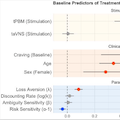
Results: Of the 58 participants, 24 were classified as treatment responders. The elastic net model showed a mean test AUC of 0.66 across 1,000 iterations, indicating modest predictive performance. Baseline craving, intervention condition, age, sex, and computational modeling parameters contributed to responder status: Higher loss aversion and lower risk sensitivity were associated with a greater likelihood of responder status.
Conclusions: Baseline computational measures, particularly loss aversion and risk sensitivity, may serve as candidate behavioral markers associated with craving reduction following non-invasive neuromodulation. Given the open-label design, these findings represent an initial proof-of-concept. Future sham-controlled studies are needed to determine whether these parameters are associated with stimulation-specific responses or more general susceptibility to behavioral change.