Abstract
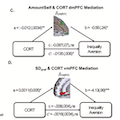
In this study, we present behavioral, computational, and neuroimaging evidence that social stress enhances intuitive prosocial value processing while impairing self-reward processing. When deciding on monetary rewards for individuals at various social distances, participants who exhibited elevated cortisol levels following a social stress task were more inclined to choose a disadvantageous unequal option. Neuroimaging data revealed that participants more likely to choose the disadvantageous unequal option exhibited increased encoding of otherregarding rewards in the ventral medial prefrontal cortex (mPFC), whereas the dorsal mPFC exhibited a decrease in encoding. Mediation analyses further indicated that both the ventral and dorsal mPFC indirectly mediated the relationship between heightened cortisol levels and a greater likelihood of choosing a disadvan-tageous unequal option. Additionally, effective connectivity analysis results demonstrated that cortisol has an excitatory effect on the dorsal mPFC via the ventral striatum, while simultaneously sending inhibitory signals to the dorsal mPFC via the dorsal striatum. These findings provide empirical evidence to clarify the ambiguity surrounding the effects of stress on prosocial decision-making, suggesting that social stress disrupts deliberative decision-making while simultaneously promoting intuitive prosocial motivation through the differential modu-lation of hierarchically organized cortico-striatal loops.