Abstract
Background: Alcohol use disorder (AUD) is a highly prevalent psychiatric condition associated with substantial morbidity and mortality. AUD is also characterized by heterogeneity in drinking motives and dynamic fluctuations in cognitive, psychological, and contextual factors that are difficult to fully capture using traditional self-report measures. Computational markers, such as delay discounting, ambiguity tolerance, and risk preference, may provide useful indicators of day-level drinking risk, but have rarely been assessed repeatedly in real-world settings or integrated with ecological momentary assessment (EMA) and passive smartphone-derived measures.
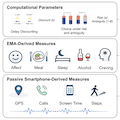
Methods: We conducted a 28-day longitudinal study in individuals with problematic alcohol use (N = 213), of whom 57 with AUDIT-K scores above 20 and app adherence above 70% were included in the main analyses. Participants completed daily EMA-derived measures of drinking and psychological states, two decision-making tasks (delay discounting and choice under risk and ambiguity), and continuous passive smartphone sensing (GPS, phone call logs, step counts, and app usage). Generalized linear mixed-effects models were used to examine associations between same-day nighttime drinking and computational parameters, EMA-derived measures, and passive smartphone-derived measures. Subgroup analyses stratified participants by dominant drinking motive.
Results: A multimodal model combining computational parameters, EMA-derived measures, and passive smartphone-derived measures showed the highest explanatory power for same-day nighttime drinking. Higher daily delay discounting [log(k)] was associated with increased likelihood of nighttime drinking (β = 0.39, SE = 0.17, p = .021). In externally motivated drinkers, higher log(k), lower meal intake, less time spent at home, and higher craving were associated with nighttime drinking, whereas mood was not. In internally motivated drinkers, positive mood and craving, but not log(k) or the passive smartphone-derived measures, were associated with nighttime drinking. An interaction between log(k) and drinking motive indicated that the association between delay discounting and drinking was specific to externally motivated individuals (β = 1.05, SE = 0.35, p = .002).
Conclusions: Daily fluctuations in delay discounting, EMA-derived psychological measures, and passive smartphone-derived measures were jointly associated with same-day nighttime drinking in individuals at high risk for AUD. The association between delay discounting and nighttime drinking was stronger among individuals with external drinking motives. Combining computational parameters, EMA-derived measures, and passive smartphone-derived measures may support the development of personalized, timely interventions that target individual risk for drinking.